Quick Answer
-
Dubai does not currently impose a conventional annual tax based on the market value of individually owned residential property.
-
Dubai Land Department lists a 4% total sale-registration fee. Its current sale-registration service allocates 2% to the seller and 2% to the buyer.
-
Buyers using a mortgage can also pay a DLD registration fee equal to 0.25% of the mortgage value.
-
Owners may still face service charges, municipality housing fees in relevant cases, maintenance costs, and VAT on certain property-related supplies.
-
Pakistani tax residents may have separate foreign-income and foreign-asset reporting duties under Pakistan's tax rules.
Buyers researching property tax in Dubai often hear that Dubai has “zero property tax.” That description captures part of the picture, but it does not show the full cost of owning real estate. Dubai's current framework does not impose a conventional annual tax tied to the market value of an individually owned residential home.
Buyers still pay other costs. These can include Dubai Land Department registration fees, mortgage-registration fees, service charges, municipality housing fees, and VAT in certain situations. The exact treatment also changes between residential and commercial property, personal ownership and business activity.
This guide explains what Dubai property owners actually pay in 2026. It covers DLD fees, annual ownership costs, VAT, rental income, gains on sale, foreign ownership, and current Pakistan tax considerations. Pakistani buyers can also use our Best Properties in Dubai guide when comparing property types and locations.
How Does Property Tax in Dubai Work?
Dubai's property framework separates ownership taxes from transaction fees and running costs. A buyer does not receive a yearly bill calculated as a percentage of the home's current market value in the way many annual property-tax systems operate.
However, no annual value-based property tax does not mean property ownership has no costs. Government registration fees can apply when ownership changes. Owners can also pay building service charges, applicable municipality fees, utilities, maintenance, and other property-specific expenses.
The UAE Government's tax guidance also confirms that the UAE does not levy personal income tax on individuals. That rule is separate from property-registration fees and property operating costs.
What Does No Annual Property Tax Mean?
An annual property tax normally uses a property's assessed or market value to calculate a recurring government charge. Dubai does not currently use that conventional model for individually held residential property.
Instead, buyers should divide their costs into three groups: purchase and registration costs, recurring ownership costs, and taxes that apply only to certain transactions or ownership structures.
Dubai Property Taxes and Costs at a Glance
|
Cost |
Current General Rule |
When It Applies |
Annual Property Tax? |
|
Annual value-based property tax |
No conventional recurring levy |
Residential ownership |
No |
|
DLD sale registration |
4% total |
Property transfer |
No |
|
Mortgage registration |
0.25% of mortgage value |
Financed purchase |
No |
|
Service charges |
Vary by project |
Jointly owned developments |
No |
|
Municipality housing fee |
Can apply based on rental value |
Housing or occupancy |
No |
|
Residential VAT |
Usually exempt, with qualifying first supplies zero-rated |
Residential transactions |
VAT rule |
|
Commercial property VAT |
Generally 5% |
Commercial sales and leases |
VAT rule |
Dubai Land Department's current Property Sale Registration service lists a 2% seller fee and 2% buyer fee, making the sale-registration charge 4% in total.
Dubai Land Department Fees When Buying Property
The main government charge during a standard Dubai property purchase is the sale-registration fee. Buyers should treat this as a transaction cost rather than an annual tax on ownership.
The official Dubai Land Department Property Sale Registration service currently lists 2% of the sale value for the seller and 2% for the buyer. It also lists separate title, map, knowledge, innovation, and service-partner fees.
The 4% DLD Registration Fee
Dubai's legal fee framework sets the registration charge for a real-property sale at 4% of the sale-contract value. It also states that the seller and buyer share the fee equally unless they agree otherwise. The rule appears in Dubai's official property-registration fee legislation.
That distinction matters. Many guides describe the full 4% as a compulsory buyer tax, but the official rule is more precise. In practice, the sale agreement can determine who bears the cost. Buyers should therefore review the signed transaction terms rather than assume the statutory split will always apply.
One-Time Costs Buyers Should Check
-
Sale registration: DLD currently lists 2% for the seller and 2% for the buyer. The agreement can affect the final allocation.
-
Mortgage registration: DLD charges 0.25% of the mortgage value when a mortgage requires registration.
-
Title and map charges: DLD lists separate administrative fees depending on the property and transaction.
-
Registration trustee charges: Service-partner fees vary according to the transaction and sale value.
-
Commercial costs: Bank valuation, brokerage, legal advice, and financing costs are separate from government property tax.
The official DLD sale service currently lists an AED 250 title-deed fee and service-partner charges of AED 4,000 plus VAT for sales worth AED 500,000 or more, or AED 2,000 plus VAT below that threshold. These amounts can change, so buyers should confirm them at the time of purchase.
Buyers comparing completed and newly launched homes can also review our Off-Plan vs Ready Property in Dubai guide rather than repeating that buying decision here.
Who Pays the 4% DLD Fee in Dubai?
Dubai's legal framework says the seller and purchaser share the property-sale registration fee equally unless they agree otherwise. The current DLD sale-registration service therefore lists 2% for the seller and 2% for the buyer.
However, parties can agree on a different allocation. This means a buyer may contractually bear more than 2%, including the full 4%, depending on the transaction terms. The safest approach is simple. Check the sale agreement before calculating the total acquisition budget.
What Other Costs Apply to a Mortgaged Property?
Mortgage buyers face an additional registration charge.
Dubai Land Department currently lists a 0.25% mortgage-registration fee based on the mortgage value through its Mortgage Registration service. DLD also lists title-deed, knowledge, innovation, and service-partner charges where applicable.
For example, a mortgage of AED 700,000 would generate a DLD mortgage-registration charge of AED 1,750 before applicable administrative or service-partner charges.
This mortgage fee is not an annual tax. It applies to registering the mortgage.
Do Property Owners Pay Annual Costs in Dubai?
Yes. Property owners can face recurring costs even without a conventional annual property-value tax.
The most important difference is that recurring ownership expenses depend on the property and its use. An apartment owner may pay annual common-area service charges, while a villa can involve different maintenance costs.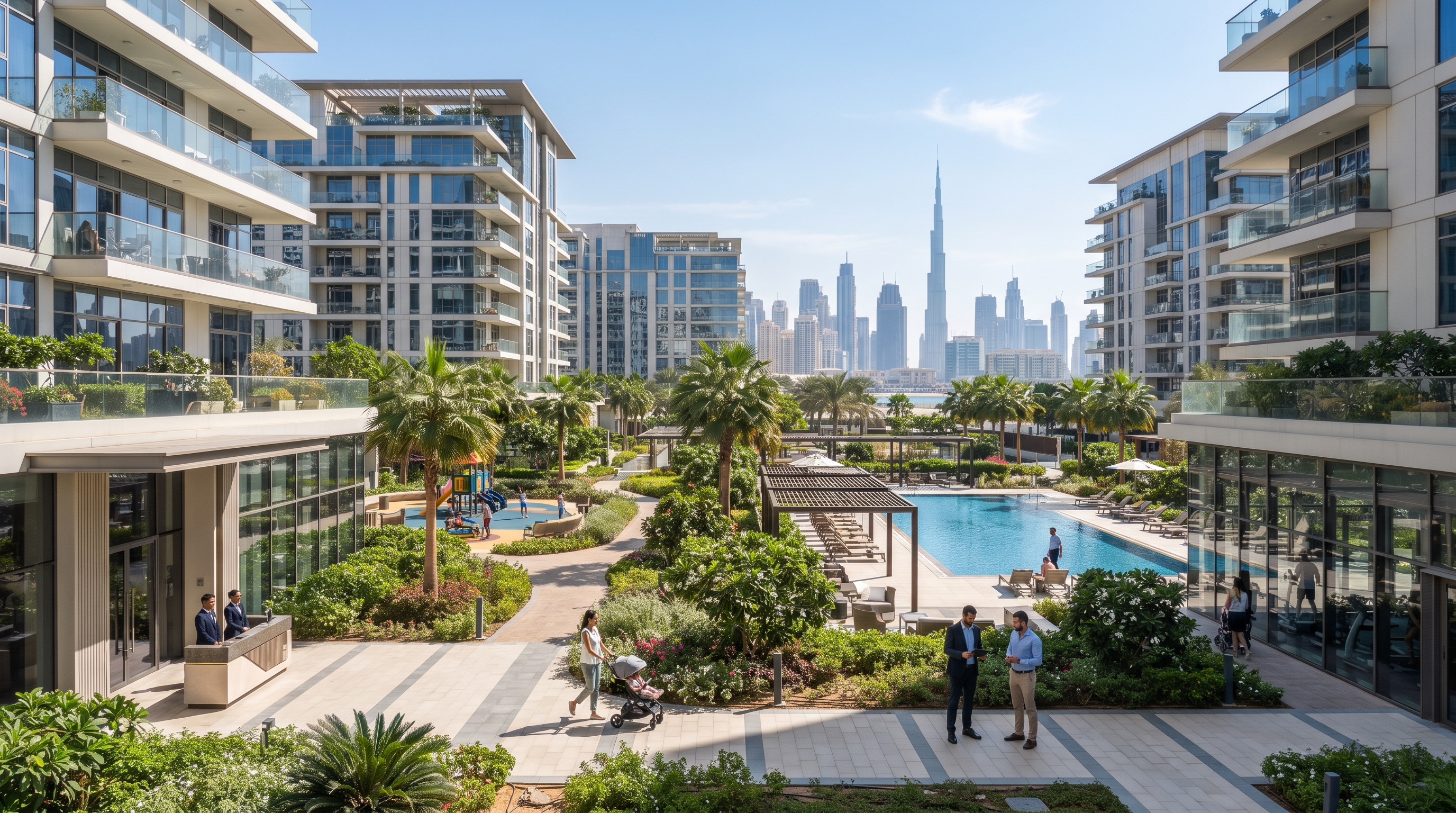
Dubai Property Service Charges
Property service charges in Dubai cover the management, operation, maintenance, utilities, insurance, administration, and reserve requirements of jointly owned developments.
Dubai Land Department explains that service charges support the management and maintenance of jointly owned property. Owners can check approved charges through the DLD Service Charge Index, which lets users search by development and year.
Service charges therefore differ from project to project. Buyers should not apply one generic Dubai rate to every apartment.
Dubai Municipality Housing Fee
Dubai Municipality also operates housing fees. The UAE Government's leasing guidance states that tenants in Dubai pay a housing fee equal to 5% of yearly rent, collected through monthly electricity and water bills.
Dubai Municipality also provides services for housing-fee adjustments on leased or owned units based on rental value through its official service portal. The housing fee is different from an annual tax based on the property's sale value.
Common Recurring Property Costs
|
Cost |
Who May Pay It? |
How It Is Determined |
|
Service charges |
Owners in jointly owned projects |
RERA-approved project budget |
|
Municipality housing fee |
Relevant occupants/units |
Rental value rules |
|
Utilities |
Occupant or owner |
Consumption |
|
Maintenance |
Owner |
Property condition and contract |
|
Property management |
Remote landlords where used |
Management agreement |
|
Insurance |
Depending on property and policy |
Insurer and coverage |
Landlords who want a deeper explanation of rental operations can use our Property for Rent in Dubai guide.
Are Service Charges a Property Tax?
No. Service charges pay for the operation and maintenance of jointly owned developments.
Dubai Land Department explains that these charges can cover management and maintenance of shared facilities and common areas. RERA approves the relevant service-charge budgets.
The Federal Tax Authority also states that service charges supplied by an owners' association or management entity conducting an economic activity can carry 5% VAT where that entity is able to register for VAT. The rule appears in the FTA's Real Estate VAT Guide. This distinction matters when calculating net property returns. A property may have no conventional annual property tax but still carry meaningful yearly service charges.
Is There VAT on Property in Dubai?
Yes, VAT can apply to real estate, but the treatment depends on the property type and transaction. The Federal Tax Authority states that sales and leases of commercial property generally attract 5% VAT. Residential property follows different rules under the FTA real-estate VAT framework.
The first supply of a new residential building within three years of completion is generally zero-rated. Subsequent residential supplies are generally VAT-exempt.
VAT on Property in Dubai
|
Property or Supply |
General VAT Treatment |
|
First qualifying supply of new residential building within 3 years |
0% VAT |
|
Later residential sale or lease |
Generally exempt |
|
Commercial property sale |
Generally 5% |
|
Commercial property lease |
Generally 5% |
|
Certain property-related services |
May attract 5% VAT |
A zero-rated transaction and an exempt transaction are not the same for VAT purposes. Buyers with commercial property or business structures should obtain tax advice for their exact transaction.
Is Rental Income Taxed in Dubai?
The UAE does not levy personal income tax on individuals. The Federal Tax Authority also states that income earned by an individual from UAE property in their personal capacity will generally not be subject to UAE Corporate Tax.
The FTA's guidance on taxation of natural persons goes further. It states that real-estate investment income is not treated as taxable business activity where a natural person earns it through property investment that does not require a business licence.
The tax treatment of rental income in Dubai therefore depends on the ownership and activity structure.
A natural person renting personally held property can receive different treatment from a company or licensed real-estate business. Buyers should avoid assuming that every rental structure receives the same tax treatment. For the wider investment picture, see our Dubai Investment Properties guide.
Is There Capital Gains Tax on Dubai Property?
For natural persons, the UAE Corporate Tax rules distinguish personal real-estate investment from business activity.
The FTA provides an example in its natural-person Corporate Tax guidance in which an individual sells a residential apartment for AED 2.5 million and makes AED 500,000 profit. The guide states that the profit is not subject to Corporate Tax because the sale did not require a business licence.
That does not mean every property sale by every ownership structure is automatically tax-free. Buyers researching capital gains tax on Dubai property should first identify the legal owner and activity. A company, licensed property activity, or other business structure can produce a different result.
Does UAE Corporate Tax Apply to Property?
It depends on who owns the property and how they conduct the activity.
The Federal Tax Authority's guidance for natural persons states that a natural person becomes subject to Corporate Tax only when they conduct a UAE business or business activity and their relevant turnover exceeds AED 1 million in the calendar year. Wages, personal investment income, and real-estate investment income do not count as business activity for this test.
The FTA also explains that a foreign individual who owns UAE property in a personal capacity would generally not face UAE Corporate Tax or related compliance obligations merely because of that investment.
Company ownership requires separate analysis. Juridical persons and businesses can fall under different Corporate Tax rules.
Is Property Tax in Dubai Different for Foreigners?
Dubai does not impose a separate conventional annual residential property-tax rate simply because an owner is foreign.
The main questions concern the property type, transaction, legal owner, financing method, and whether the property forms part of a business activity.
This means property tax in Dubai for foreigners is generally not about a special foreigner surcharge. However, foreign buyers must also consider the tax laws of their country of residence. For Pakistani buyers, that second layer can be just as important as the UAE rules.
What Should Pakistani Property Owners Know About Tax?
Pakistani nationality alone does not determine Pakistan tax liability on a Dubai property. Pakistan tax residence matters.
Under the current Income Tax Ordinance, an individual is a Pakistan resident where the applicable Section 82 conditions are met. The main presence test treats an individual as resident if they spend 183 days or more in Pakistan during the tax year. The law also contains separate rules for government employees posted abroad and certain Pakistani citizens who are not resident taxpayers elsewhere.
The previously used 120-day plus 365-day test was omitted from Section 82 and should not be used for current 2026 analysis. Buyers should confirm their status for the relevant tax year using the current FBR Income Tax Ordinance.
Pakistan's current Income Tax Ordinance framework also distinguishes resident and non-resident income. A resident person's income calculation can include Pakistan-source and foreign-source income, while a non-resident person's computation generally uses Pakistan-source income. Buyers should assess this separately from UAE tax treatment.
Foreign Income and Asset Reporting
FBR Section 116A requires a resident individual to furnish a foreign income and assets statement where either of these thresholds applies:
-
Foreign income of at least USD 10,000: This can trigger the foreign income and assets statement requirement.
-
Foreign assets worth at least USD 100,000: This can also trigger the filing requirement.
Once the requirement applies, the statement includes relevant foreign assets and liabilities, foreign assets transferred during the year, consideration received, foreign income, and related expenditure.
These are reporting thresholds, not automatic tax rates. A person may have a filing duty without the same amount becoming tax payable.
Foreign Tax Credits
FBR Section 103 allows a resident taxpayer to claim qualifying foreign-tax credit where foreign-source income is taxable in Pakistan and foreign income tax has been paid. The credit is limited to the lower of the foreign tax paid or the corresponding Pakistan tax.
However, not every payment made overseas counts as foreign income tax.
FBR Rule 15 says the foreign levy must qualify as a tax and be substantially equivalent to income tax. A payment linked to a specific economic benefit does not automatically qualify.
Therefore, Pakistani investors should not assume that DLD registration fees, Dubai service charges, or similar property costs create a foreign-tax credit in Pakistan.
Pakistan Tax Check
-
Confirm tax residence: Your Pakistan residency status can change how foreign-source income is treated.
-
Check asset-reporting thresholds: A Dubai property may trigger Section 116A reporting for a resident individual if the statutory threshold is met.
-
Review rental income separately: Dubai treatment does not automatically determine Pakistan treatment.
-
Check any property sale: A disposal can create separate Pakistan reporting or tax questions depending on your circumstances.
-
Do not confuse fees with foreign income tax: DLD registration and service charges do not automatically qualify for a Section 103 credit.
FBR's current legislation index provides the latest consolidated Income Tax Ordinance for checking current rules.
Returning expatriates can also face special rules. FBR Section 51 provides a foreign-source income exemption in specified circumstances for Pakistani citizens who become resident after being non-resident during the previous four tax years.
Example: Costs on an AED 1 Million Dubai Property
Consider a simple AED 1 million cash purchase.
The total statutory sale-registration fee equals AED 40,000 because DLD applies 4% of the sale value. Under the current DLD service, that appears as AED 20,000 for the buyer and AED 20,000 for the seller before any different contractual allocation.
Additional title, map, registration trustee, knowledge, and innovation charges can apply. A mortgage buyer would also need to add the 0.25% mortgage-registration fee to the relevant mortgage value.
Annual service charges would depend on the exact development. The DLD Service Charge Index should therefore form part of the buyer's due diligence before purchase. A buyer comparing house types and overall entry budgets can use our Dubai Villa Price guide for a separate look at villa pricing and buying costs.
What Is Not a Property Tax in Dubai?
The DLD sale-registration fee is not an annual property tax. It applies when registering the transfer & Service charges are also not property tax. They fund the operation and maintenance of jointly owned developments.
A municipality housing fee is a separate government charge linked to rental value. Mortgage registration is a financing-related registration charge while VAT also follows its own tax rules. Its application depends on the nature of the property and supply.
Understanding these differences prevents buyers from assuming that “no annual property tax” means “no property-related costs.”
How to Verify Dubai Property Taxes and Fees Before Buying
Buyers should start with the exact property and transaction rather than a generic online percentage.
Check the current DLD sale-registration service. Then confirm the fee allocation in the sale agreement, the project's RERA-approved service charges, any mortgage-registration cost, and the relevant VAT treatment.
Pakistani residents should separately review current FBR residency, foreign-income, and foreign-asset rules. UAE treatment does not cancel an obligation that may arise under Pakistan law. If residency is part of your wider property plan, our Dubai Golden Visa for Pakistani Investors guide covers that subject separately so the tax guide stays focused.
Understand Property Tax in Dubai Before You Buy
Understanding property tax in Dubai means looking beyond the simple “zero tax” headline. Dubai does not use a conventional annual value-based property tax for individually held residential homes, but buyers still need to budget for registration, service charges, possible mortgage costs, and other applicable fees.
Dubai Property Expo Pakistan can help Pakistani buyers understand how these ownership costs fit into the total budget for specific Dubai properties. You can compare ready and off-plan options, payment structures, project charges, and purchase costs before choosing a property.
If you want to compare Dubai properties with a clearer view of the full ownership budget, register your interest with Dubai Property Expo Pakistan. You can then discuss suitable projects and the costs that need verification before purchase.
Frequently Asked Questions
Does Dubai Have Property Tax?
Dubai does not currently impose a conventional recurring tax based on the market value of individually owned residential property. Buyers and owners can still pay DLD registration fees, service charges, municipality fees, and other transaction-specific costs.
How Much Is Property Tax in Dubai?
There is no standard annual percentage-based residential property tax comparable to conventional annual property-tax systems. However, DLD currently charges 4% in total to register a standard property sale, alongside other applicable fees.
Who Pays the 4% DLD Fee in Dubai?
Dubai's official framework allocates the sale-registration fee equally between seller and buyer unless they agree otherwise. The current DLD sale service lists 2% for the seller and 2% for the buyer.
Do Foreigners Pay Property Tax in Dubai?
Dubai does not apply a separate conventional annual residential property-tax rate simply because the owner is foreign. Foreign owners should still check Dubai transaction costs and any tax obligations in their country of residence.
Is Rental Income Taxed in Dubai?
The UAE does not levy personal income tax on individuals. Qualifying UAE real-estate investment income earned by a natural person in a personal capacity will also generally fall outside UAE Corporate Tax, subject to the FTA rules.
Is There Capital Gains Tax on Dubai Property?
The FTA's natural-person guidance shows that profit from selling personally held real estate can fall outside UAE Corporate Tax where the activity qualifies as real-estate investment and does not require a business licence. Company or business ownership can produce a different tax result.